
Brand Logo
Solutions

Patagonia services for carry-system sampling and channel pack-out

Sampling, private-label marks, carton packing and textile files are sequenced so a buyer can see which task owns denier confirmation, which owns hangtag copy, and which owns the social-audit pack. Stock-wholesale and private-label OEM run on different clocks; they are not ranked as a quality contest.

Service pillars that stay on a horizontal review rail

Scroll the cards on desktop. Each pillar names a deliverable, a typical cycle and the file a technical buyer should expect. Figures are planning ranges until a named construction is confirmed.

01

Construction sampling

A first proto locks fabric denier, zipper gauge and harness geometry. Size-set samples then confirm torso-length windows for 22 L, 30 L, 50 L and 65 L hiking packs before a colorway is frozen. Typical proto cycle is quoted in business days on the proposal.
02

Private-label execution

Heat-transfer, embroidery and woven-label placements are drawn on a tech pack. Panel print is scoped only when a fabric can hold the ink; TPU-laminated Black Hole panels often cannot. MOQ is stated per colorway and per decoration method.

03

Wholesale carton logic

Inner polybag, hangtag, barcode placement and master-carton drop tests are listed for retail and e-commerce inbound. Duffels in the 40–70 L Black Hole window need different cube notes than a 22 L commute daypack.

04

Textile dossier support

When a channel asks for OEKO-TEX STANDARD 100, bluesign mill inputs or an amfori BSCI site summary, the request is logged against named materials and a named factory. ISO 9001:2015 describes the quality system, not a fabric certificate.

05

Channel pack-out

Dealer assortments, club-team color blocks and e-commerce inbound cartons keep separate mark files. A Refugio travel backpack and a framed hiking pack can share a purchase order only when carton marks stay distinct.

Impact counters used as planning ranges, not market-share claims

These figures describe the review window used when a buyer submits volume, channel and target market. They are not certified public performance results and they are not a claim that one chassis is twice as durable as another without a named abrasion method.

5 Business days for an OEM proposal after a complete tech-pack intake
3 Business days to assemble a requested textile and social-audit dossier
1 Business day target for stock-item quotes when SKU and Incoterms are named
4 Decoration methods scoped: heat-transfer, embroidery, woven label, panel print

Stock-versus-private-label is treated as a channel decision. A wholesale colorway can share a construction with an OEM run and still differ on hangtag, carton mark and restricted-substance file. A rain-film change from DWR plus PU coating to a laminated membrane is a new sample, because hydrostatic head, stiffness and zipper tape all move.

Limits written into the quote: DWR plus PU coating is not a dry-bag; TPU lamination on a Black Hole duffel is not a hiking frame; a one-size foam pad is not a torso-length harness; kids 20 L packs do not inherit 65 L overnight copy. Loaded torso-board and zipper-cycle checks are the sample methods; they are not a published third-party round-robin dataset.

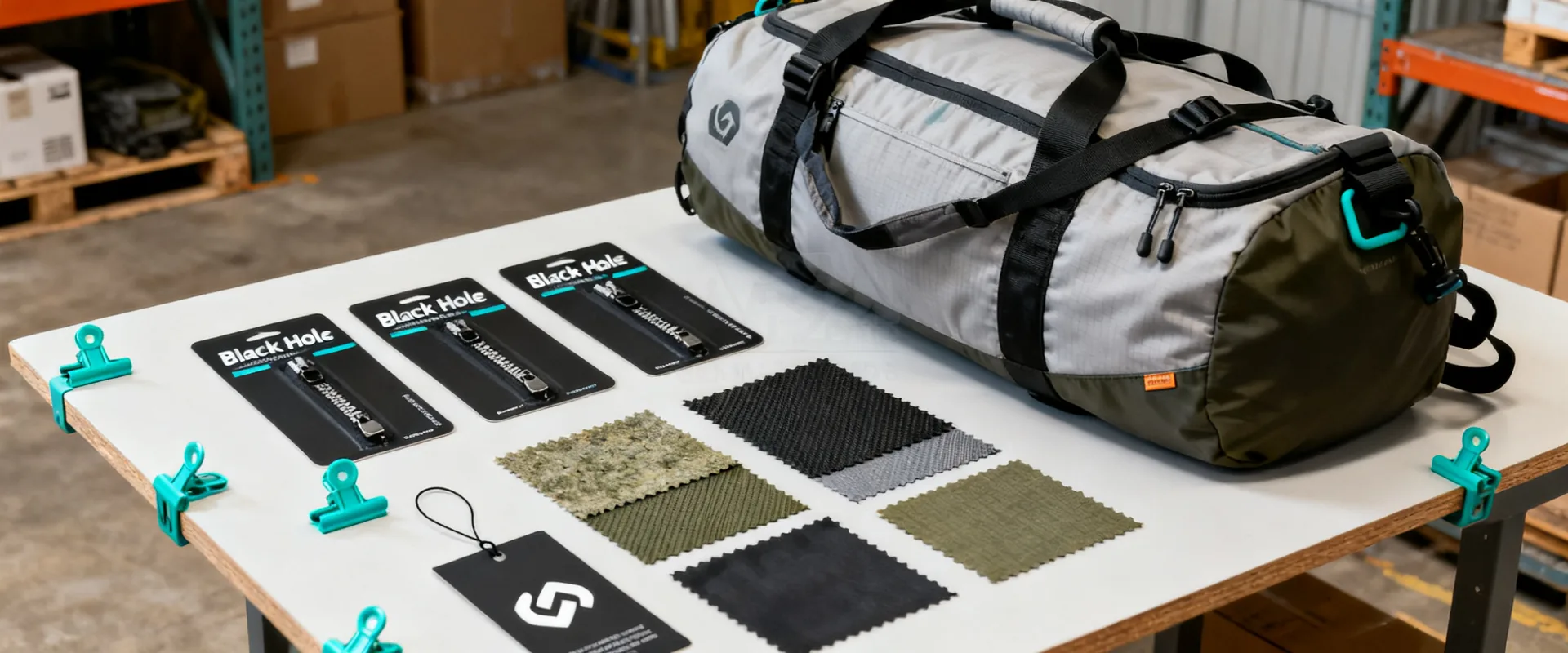
Sampling table with pack proto, zipper cards and fabric swatches

Request a Patagonia capability audit for your pack program

Include annual quantity, private-label marks, target market and whether you need ISO 9001:2015, BSCI or OEKO-TEX files with the first proposal.